
AI Voice Assistants: Revolutionizing Law Firm Client Engagement & Growth
The legal landscape is undergoing an unprecedented transformation, driven by technological advancements and an increasingly demanding client base. For law firm owners, attorneys, and legal professionals, the pressure to deliver exceptional service, manage burgeoning caseloads, and maintain operational efficiency has never been higher. Clients today expect instant responses, round-the-clock availability, and personalized interactions – a stark contrast to the traditional office hours and often delayed communication channels that have long defined the legal industry. This evolving expectation isn't just a trend; it's a fundamental shift in how legal services are accessed and delivered, pushing firms to reconsider their foundational operational strategies. The challenge lies in scaling human capacity to meet these demands without compromising the quality and personal touch that define legal counsel. As firms grapple with the complexities of client intake, routine inquiries, and appointment scheduling, the administrative burden can quickly detract from core legal work, impacting productivity and, ultimately, profitability. The question is no longer if technology will reshape law, but how rapidly and effectively firms can integrate it to stay competitive and client-centric.
A recent trending news article, '26 Call Center Statistics That Reveal Where AI Is Actually Working in 2026,' highlights a crucial parallel that law firms must heed. While the article focuses on broader contact center transformation, its core message—that 'AI adoption is soaring, but integration lags'—resonates deeply within the legal sector. Law firms, at their essence, operate as highly specialized contact centers, fielding inquiries, managing client relationships, and coordinating complex schedules. The statistics emerging from the wider customer service industry offer a powerful lens through which to view the future of legal client engagement. They reveal not just the potential for AI, but also the pitfalls of fragmented or poorly executed integration. For legal professionals, understanding these trends means recognizing that the same forces driving efficiency and client satisfaction in retail, banking, and tech are now knocking on the doors of legal practices. The firms that proactively address the 'integration lag' will be the ones that redefine excellence in legal service delivery, leveraging AI to streamline operations and elevate the client experience beyond traditional capabilities.
This is where the transformative power of AI Voice Assistants comes into play, offering a sophisticated, scalable solution tailored specifically for the unique demands of the legal industry. Far beyond simple automated phone menus, modern AI Voice Assistants leverage advanced natural language processing (NLP) and machine learning to understand, respond, and even anticipate client needs with remarkable accuracy and empathy. Imagine a system that can not only answer common questions about your firm's practice areas but also pre-qualify leads, book appointments directly into your calendar, and even provide multilingual support to a diverse clientele – all while your legal team focuses on high-value casework. The promise of AI in call centers is directly transferable to the legal front office, mitigating the challenges of missed calls, overburdened staff, and inconsistent client communication. By strategically adopting AI Voice Assistants, law firms can bridge the gap between soaring client expectations and the practical realities of a busy legal practice, turning potential integration lags into a significant competitive advantage. This technology isn't just about efficiency; it's about fundamentally enhancing the client journey and empowering legal professionals to deliver superior service.
The Evolving Landscape of Legal Client Communication
In today's hyper-connected world, client expectations for responsiveness and accessibility have dramatically escalated, profoundly impacting how law firms must engage with their clientele. Gone are the days when a simple voicemail or an email response within 24-48 hours was considered acceptable. Modern clients, accustomed to instant gratification from services like Amazon, Uber, and Netflix, expect their legal providers to offer similar levels of immediate interaction and seamless support. They seek information swiftly, demand updates proactively, and anticipate personalized communication that acknowledges their unique legal situation. This shift isn't merely a preference; it's a new baseline for client satisfaction, and firms that fail to adapt risk falling behind. The pressure to maintain a constant, high-quality communication channel while simultaneously managing complex legal work creates an immense strain on existing resources, often leading to overworked staff and missed opportunities for client engagement.
Contrast this with the traditional law firm model, which often operates within rigid office hours, relying on human receptionists who can only manage one call at a time and are unavailable after closing. This creates significant bottlenecks, particularly for potential clients who may be reaching out during non-business hours, often during moments of personal crisis or urgent need. A missed call, especially from a prospective client, is not just an inconvenience; it represents a lost opportunity, a potential case walking out the door before a conversation even begins. Industry reports frequently highlight that clients will move on to the next firm if they don't receive an immediate response. For a law firm, where each new client represents substantial revenue potential and the opportunity to build a long-term relationship, the cost of these missed connections can be staggering, eroding growth prospects and competitive standing. The reliance on manual processes and limited availability is increasingly unsustainable in an always-on economy.
The insights from the broader 'call center statistics' are remarkably pertinent here. These reports consistently show that customer service expectations are at an all-time high, with 80% of consumers expecting immediate responses, and a significant portion preferring self-service options for routine inquiries. While law firms are not typical call centers, they function as critical communication hubs for their clients. Every incoming call, every website inquiry, every email represents a client interaction that shapes their perception of the firm. The challenges of call volume, agent availability, and consistent information delivery, which plague traditional contact centers, are mirrored in law firms struggling with high call volumes, busy receptionists, and the need to provide accurate, up-to-date information across multiple channels. Understanding these industry-wide trends allows legal professionals to proactively address their own communication challenges with proven technological solutions.
Ultimately, law firms are, in essence, highly specialized contact centers for their clients, managing sensitive information, providing expert guidance, and building trust through every interaction. The administrative burden associated with this role – screening calls, answering frequently asked questions, scheduling appointments, and routing inquiries – can consume a significant portion of a legal team's valuable time. This diversion from core legal work not only impacts productivity but also contributes to burnout and reduces the capacity for strategic planning and client advocacy. By acknowledging this parallel with broader contact center operations, law firm leaders can leverage the advancements made in AI-driven customer service to their advantage, recognizing that solutions designed to optimize client interaction in other sectors hold immense potential for revolutionizing their own client engagement strategies and operational efficiency. The integration of intelligent automation is no longer a luxury but a strategic imperative for sustained growth and client satisfaction in the legal field.
Beyond Simple Answering: The Power of AI Voice Assistants
Modern AI Voice Assistants for law firms transcend the rudimentary capabilities of traditional interactive voice response (IVR) systems. These are not merely automated menus that direct callers to press '1 for this' or '2 for that.' Instead, today's AI Voice Assistants are powered by sophisticated Natural Language Processing (NLP) and machine learning algorithms, enabling them to understand, interpret, and respond to complex human speech with remarkable accuracy and nuance. They can engage in natural, flowing conversations, grasp the intent behind a caller's words, and access vast amounts of information to provide relevant answers. This advanced intelligence allows them to mimic human interaction, providing a seamless and professional experience that significantly elevates client satisfaction. The shift from rigid, rule-based systems to flexible, intelligent conversational agents represents a paradigm change in how law firms can manage their front-line client interactions, ensuring every caller feels heard and understood, regardless of the complexity of their inquiry.
The specific capabilities of these advanced AI Voice Assistants are directly applicable to the daily operational demands of a busy law firm. Imagine an AI that can efficiently pre-qualify leads by asking targeted questions about their legal needs, ensuring that only genuinely viable prospects are passed on to your attorneys. It can handle appointment booking by integrating directly with your firm's calendar, suggesting available slots and confirming details, eliminating the back-and-forth typically involved in scheduling. Furthermore, these assistants can answer a wide range of frequently asked questions, such as 'What types of cases do you handle?' 'What are your initial consultation fees?' or 'What documents do I need for a divorce filing?' freeing up your staff from repetitive inquiries. Crucially, they can offer multilingual support, instantly catering to a diverse clientele and ensuring no potential client is alienated due to language barriers, thereby significantly expanding your firm's reach and inclusivity.
The efficiency gains derived from implementing AI Voice Assistants are substantial and immediately impactful. By automating the handling of routine inquiries, lead qualification, and appointment scheduling, law firms can dramatically reduce the administrative overhead that often burdens legal staff. This automation liberates paralegals, legal assistants, and even attorneys from time-consuming, repetitive tasks, allowing them to redirect their focus to more complex legal work, client advocacy, and strategic case management. Industry data suggests that AI can resolve up to 80% of routine customer service inquiries, a statistic that translates directly to significant time savings for law firms. This reallocation of resources not only boosts overall productivity but also enhances job satisfaction for staff, who can engage in more challenging and rewarding aspects of their profession. The improved response times and 24/7 availability also lead to higher client satisfaction, as clients receive immediate assistance whenever they need it.
The news snippet's mention of 'integration lags' highlights a common concern with new technologies. However, purpose-built AI solutions for specific industries like the legal sector are designed to overcome these challenges. Unlike generic AI tools, these specialized Voice Assistants understand legal terminology, compliance requirements, and the unique workflow of a law firm. They are developed with the specific nuances of legal client interactions in mind, ensuring a more seamless and effective integration process. This targeted approach minimizes the learning curve and maximizes the return on investment, allowing firms to quickly realize the benefits without extensive custom development or disruption to existing operations. By choosing an AI Voice Assistant designed for legal professionals, firms can confidently adopt this technology, knowing it is tailored to meet their precise needs and integrate harmoniously into their practice management systems, effectively bridging any potential integration gaps.
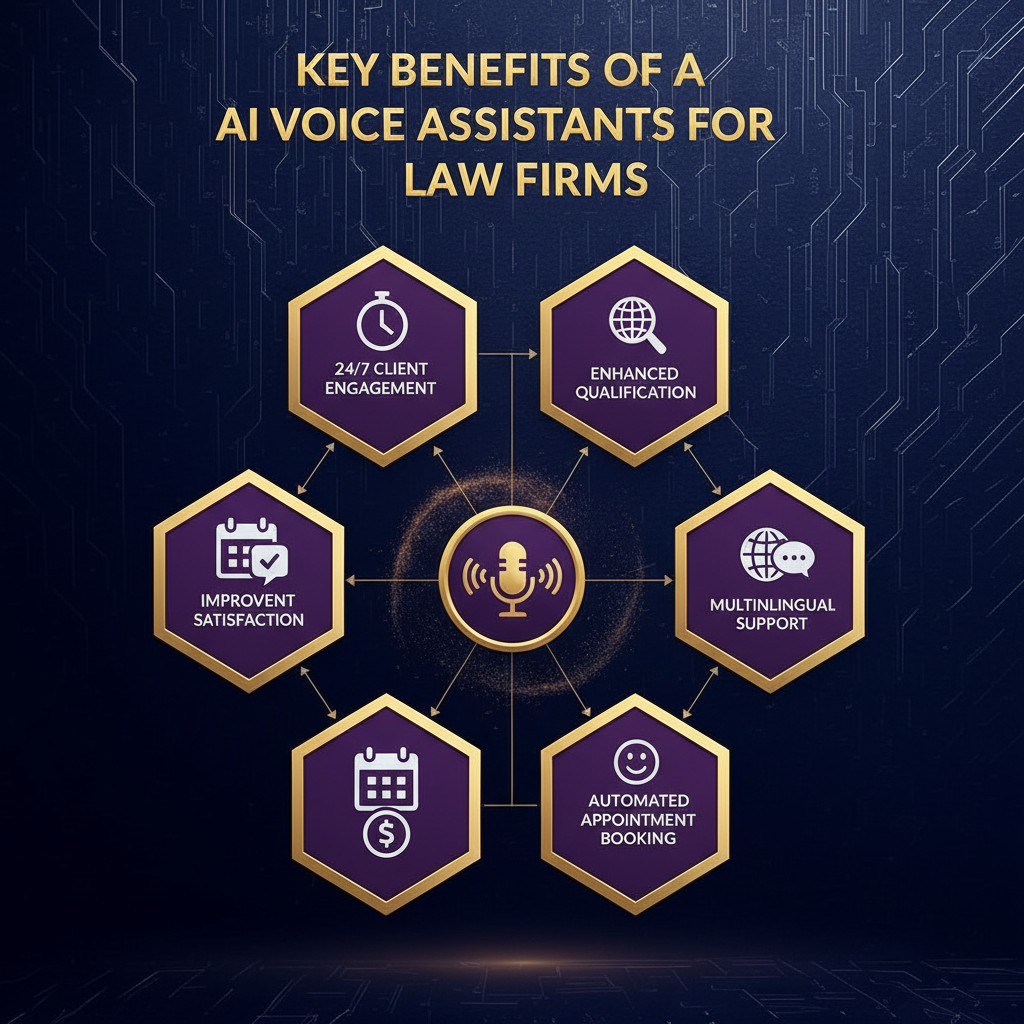
- ✓24/7 client engagement, ensuring no inquiry or lead is ever missed, regardless of time zone or office hours.
- ✓Enhanced lead capture and qualification, intelligently screening prospects to deliver only high-value cases to your legal team.
- ✓Automated appointment scheduling, seamlessly integrating with firm calendars to book consultations without human intervention.
- ✓Significant cost reduction by minimizing administrative overhead and reducing the need for extensive human receptionist staff.
- ✓Improved client satisfaction through instant responses, consistent information delivery, and personalized interactions.
- ✓Multilingual support, broadening your firm's reach and inclusivity by assisting diverse clients in their preferred language.
- ✓Data-driven insights into client interactions, providing valuable analytics to optimize marketing and service strategies.
Real-World Impact: Statistics and the Future of Legal AI
The real-world impact of AI Voice Assistants on client engagement and operational efficiency in the legal sector is becoming increasingly evident, substantiated by growing industry statistics. While specific data for law firms is still emerging, broader trends in customer service provide compelling evidence. Reports from leading analytics firms consistently indicate that businesses adopting AI for customer service can achieve remarkable improvements: a 25-30% reduction in call wait times, an increase in first-call resolution rates by up to 20%, and a significant boost in customer satisfaction scores. For law firms, these figures translate directly into a tangible competitive advantage. Imagine prospective clients receiving immediate answers and scheduling consultations without delay, or existing clients getting quick updates on their case status. This level of responsiveness cultivates trust and loyalty, distinguishing a firm in a crowded legal market. The ability of AI to handle a high volume of inquiries simultaneously ensures that peak call times no longer lead to frustrated clients or lost opportunities, fundamentally altering the firm's capacity for service delivery.
Firms that proactively embrace AI Voice Assistants are positioning themselves at the forefront of legal innovation, creating a significant competitive advantage over those clinging to outdated manual processes. In an era where digital presence and client experience are paramount, the ability to offer 24/7 support, instant information, and seamless scheduling is no longer a luxury but a strategic imperative. Early adopters are already reporting substantial gains in lead conversion rates, client retention, and overall operational fluidity. This technological edge allows them to scale their operations more effectively, handle a larger influx of clients without proportional increases in staff, and provide a consistently high level of service that builds a strong reputation. As the legal industry continues to evolve, firms leveraging AI will be better equipped to adapt to changing client demands, regulatory shifts, and market dynamics, ensuring long-term sustainability and growth.
The future trajectory of legal AI extends far beyond current capabilities, promising even deeper integration and more sophisticated functionalities. We can anticipate AI Voice Assistants evolving to offer predictive analytics, identifying potential client needs based on interaction history and demographic data, allowing for hyper-personalized outreach and service. Imagine an AI that not only books an appointment but also proactively sends relevant preparatory documents or FAQs based on the client's specific legal issue. Further integration with case management systems will enable AI to provide real-time case updates, answer complex procedural questions, and even assist with document collection by guiding clients through necessary steps. This evolution will transform the client journey into a highly streamlined, intuitive, and supportive experience, minimizing friction and maximizing satisfaction. The continuous learning capabilities of AI mean these systems will only become more intelligent and effective over time, constantly refining their ability to serve legal clients.
Addressing concerns that AI might dehumanize legal service, it's crucial to understand that the strategic implementation of AI Voice Assistants actually enhances the human element of legal practice. By offloading routine, repetitive, and administrative tasks to AI, legal professionals are freed from the mundane and empowered to focus on the truly complex, empathetic, and strategic aspects of their work. Attorneys and paralegals can dedicate more time to in-depth client consultations, nuanced legal research, courtroom strategy, and providing the personal attention that only a human can offer, particularly during sensitive legal matters. AI takes care of the transactional, allowing humans to excel at the transformational. This synergy ensures that clients receive the best of both worlds: the efficiency and instant access of advanced technology, combined with the irreplaceable wisdom, empathy, and advocacy of their human legal team. The goal is not to replace human interaction but to augment it, making legal professionals more effective and client relationships more profound.
Overcoming Integration Challenges: A Strategic Approach for Law Firms
The news snippet's observation about 'integration lags' in AI adoption is a critical point that law firms must acknowledge and strategically address. While the potential benefits of AI are immense, the successful implementation of any new technology hinges on seamless integration with existing workflows and systems. Many organizations encounter challenges when attempting to shoehorn generic AI solutions into specialized environments, leading to inefficiencies, data silos, and user frustration. For law firms, this means recognizing that legal practice has unique demands, including stringent confidentiality requirements, complex terminology, and specific operational protocols. A 'one-size-fits-all' AI solution designed for a general customer service context is unlikely to integrate effectively or provide optimal value within a legal framework. Therefore, firms must adopt a deliberate, informed approach to AI integration, prioritizing solutions that understand and respect the nuances of the legal industry to avoid common pitfalls.
The key to overcoming these integration challenges lies in selecting AI solutions that are specifically designed for, or highly adaptable to, the legal industry. This means choosing platforms where the AI's natural language processing has been trained on legal jargon, where its functionalities align with typical law firm operations (e.g., case intake, conflict checks, document automation), and where its development team understands the regulatory and ethical landscape of legal practice. Such specialized AI Voice Assistants are built with the legal professional in mind, ensuring that they can communicate effectively with clients using appropriate terminology, handle sensitive information securely, and integrate smoothly with common legal tech stacks, such as practice management software, CRM systems, and calendaring tools. This tailored approach significantly reduces the friction associated with new technology adoption, allowing firms to leverage AI's power without extensive customization or disruption.
A phased implementation strategy is also crucial for successful AI integration within a law firm. Instead of attempting a massive, firm-wide overhaul at once, a more prudent approach involves introducing AI Voice Assistants incrementally. Firms can start by deploying the AI for specific, high-volume functions, such as initial client intake and appointment scheduling, where the return on investment (ROI) can be quickly measured and demonstrated. This allows the firm to gather valuable feedback, fine-tune the AI's performance, and gradually expand its responsibilities as confidence grows. A phased rollout minimizes risk, provides opportunities for staff training and adaptation, and ensures that the AI is integrated thoughtfully, allowing the firm to learn and iterate throughout the process. This strategic, measured approach helps to mitigate the 'integration lags' by building a robust foundation for AI adoption.
Finally, and perhaps most critically for law firms, data security and compliance must be at the forefront of any AI integration strategy. Legal professionals handle highly sensitive and confidential client information, making adherence to regulations like attorney-client privilege, HIPAA (if applicable), and various data protection laws non-negotiable. Any AI Voice Assistant implemented must meet the highest standards of data encryption, privacy protocols, and secure data handling. Firms need to ensure that the AI solution provider has robust security measures in place, undergoes regular audits, and is transparent about its data processing practices. Choosing a reputable AI partner that prioritizes legal compliance and data integrity is paramount, as a breach in this area could have catastrophic consequences for a firm's reputation and legal standing. By addressing these security and compliance concerns upfront, law firms can confidently integrate AI, knowing their clients' sensitive information remains protected.

HODOS 360's AI Voice Assistants: Your Firm's Competitive Edge
In a legal landscape increasingly defined by client expectations and technological innovation, HODOS 360 emerges as the definitive solution for law firms seeking to gain a decisive competitive edge. Our AI Voice Assistants are not merely a feature; they are a sophisticated, purpose-built ecosystem designed to revolutionize how your firm interacts with clients and manages its operations. We understand the unique demands of legal practice – the need for precision, confidentiality, and unparalleled client service. That's why our AI Voice Assistants go beyond generic automation, offering intelligent, empathetic interactions that reflect the professionalism and expertise of your firm. By partnering with HODOS 360, you're not just adopting technology; you're investing in a strategic asset that will transform your client engagement, streamline your workflow, and position your firm as a leader in the modern legal era. We bridge the gap between human capacity and digital demand, ensuring your firm is always available, always responsive, and always ahead.
HODOS 360's AI Voice Assistants are engineered with a comprehensive suite of features specifically tailored to the needs of law firms. Our 24/7 phone answering capability ensures that no potential client call or urgent inquiry is ever missed, capturing leads and providing immediate support even outside of traditional office hours. This constant availability directly addresses the modern client's expectation for instant communication, significantly boosting lead conversion rates. The sophisticated lead qualification system intelligently screens callers, gathering critical information and identifying high-value prospects, ensuring your attorneys spend their valuable time on qualified cases. Furthermore, our AI seamlessly handles appointment booking, integrating directly with your firm's calendar to schedule consultations efficiently and accurately, eliminating administrative back-and-forth. Crucially, HODOS 360 offers robust multilingual support, enabling your firm to serve a diverse client base effectively, expanding your market reach and fostering inclusivity without additional staffing costs or language barriers.
One of the most significant advantages of HODOS 360 is its seamless integration capabilities, directly addressing the 'integration lags' highlighted in broader industry trends. Our AI Voice Assistants are designed to work harmoniously with your existing law firm management systems, including CRMs, calendaring software, and our own comprehensive AI Law Firm Management System. This ensures a smooth transition and maximizes the value of your current technological investments. The AI learns your firm's specific protocols, practice areas, and preferred client communication styles, making it an extension of your team rather than a separate, disjointed tool. By centralizing client interactions and data within a unified platform, HODOS 360 eliminates data silos, enhances data accuracy, and provides a holistic view of client engagement. This integrated approach minimizes disruption, accelerates adoption, and ensures that your firm realizes the full potential of AI-powered automation without the typical headaches of complex tech rollouts.
Embrace the future of legal practice with HODOS 360's AI Voice Assistants and transform your firm into a beacon of efficiency, client satisfaction, and sustainable growth. Imagine your legal team freed from administrative burdens, able to dedicate their full attention to complex legal strategy and profound client advocacy. Picture a firm where every client feels heard, every inquiry is promptly addressed, and every opportunity is seized, regardless of the time of day. HODOS 360 provides not just a service, but a strategic partnership, empowering your firm to navigate the evolving legal landscape with confidence and innovation. Don't let your firm be left behind by the accelerating pace of AI adoption. Discover how HODOS 360 can redefine your client experience, optimize your operations, and secure your firm's competitive advantage. Contact us today for a personalized demonstration and take the first step towards a more efficient, client-centric, and prosperous future.